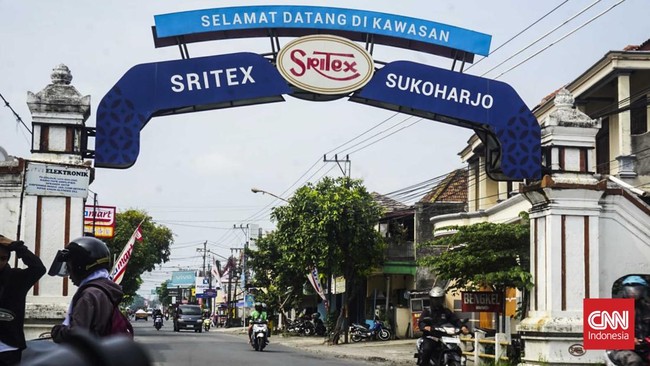
The Sritex Group was once a leading Indonesian textile manufacturer. It officially ceased operations on March 1, 2025. This closure led to the layoff of approximately 10,665 employees. Sritex was founded in 1966 in Solo, Central Java. It evolved from a small fabric shop into a major textile producer. The company supplied military uniforms and garments to global retailers like H&M, Uniqlo, and Zara. So, how does a big company collapse?
A Collapse That No One Saw Coming
It is definitely sad news for many Indonesians. A huge company with a rich history and countless personal stories has suddenly crumbled in the blink of an eye. These mass layoffs have been accumulating since August 2024, with 340 workers initially laid off. The layoffs continued until March 2025, reaching a total of approximately 10,000 employees. The company claims that it can’t pay its debt. This collapse delivers a huge blow to the workers, whose livelihoods depend entirely on the “No Work, No Pay” scheme. Some of them have been working there for decades. Hence, this brings up the question:
What actually drives the collapse?
To untangle this case, let’s take a look at the circumstances surrounding it through the PESTEL framework.
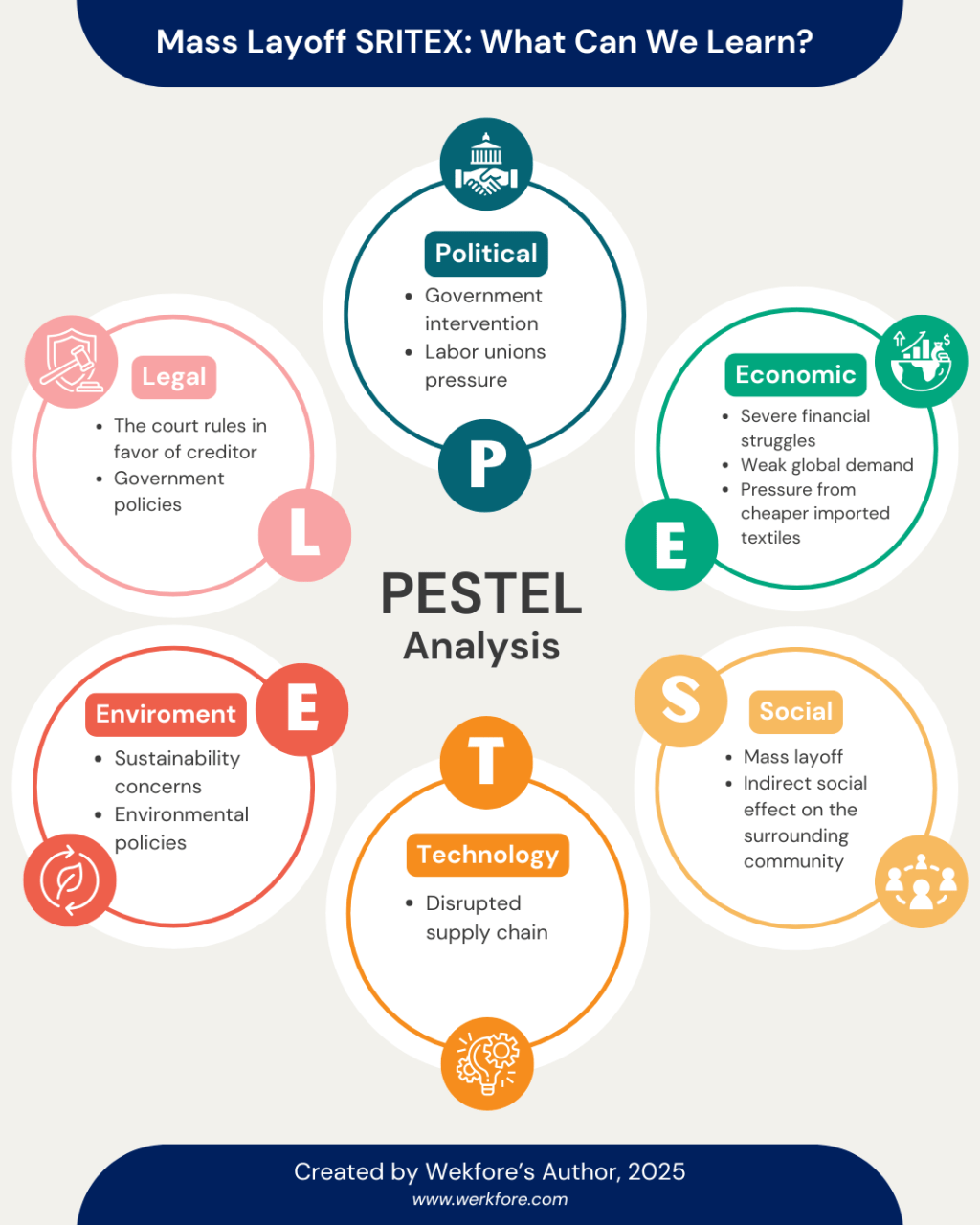
Political Factors. Government intervention has played a significant role. President Prabowo Subianto directed ministers in October 2024 to find solutions to save Sritex. The Semarang Commercial Court declared the company bankrupt. This was due to its failure to meet debt obligations to PT Indo Bharat Rayon. The government did not offer direct financial assistance. Instead, it opted to oversee the situation. It acted as a facilitator in Sritex’s rescue efforts. Labor unions have also pushed for a bailout to prevent mass layoffs, reflecting political pressure to protect employment.
In response, the Ministry of Industry (Kemenperin) considered the possibility of a bailout fund or other incentives to support Sritex. The government was also working on a broader rescue scheme. This included potential financial aid. However, the exact model remained under discussion.
However, there has been no official confirmation of the success of these rescue efforts, and the final outcome remains uncertain. Several challenges threaten the viability of the recovery plan. These include Sritex’s massive debt burden of approximately $1.6 billion. The government has a limited role in stabilizing the company’s financial condition. There is also weak global demand coupled with competition from cheaper imported products. These factors will ultimately lead to the failure of the rescue efforts.
Economic Factors. Sritex has faced severe financial struggles since the COVID-19 pandemic, which disrupted supply chains and reduced consumer demand. Sales fell from $1.3 billion in 2019 to $847 million in 2020, further worsening its financial condition. By mid-2024, its debt had risen to $1.6 billion, leading to significant instability. Additionally, weak global demand and competition from cheaper imports have further eroded its market share and profitability. Government policies facilitating textile imports, particularly from China, have intensified these pressures, making it even harder for Sritex to compete.
Social Factors. The company employs approximately 10,665 people, but financial troubles have led to temporary layoffs. Community concerns about mass job losses highlight Sritex’s role in social stability. Additionally, the layoffs have a domino effect, indirectly impacting other people’s livelihoods. For instance, families of workers who depended on the factory’s wages are now struggling to find new sources of income. Moreover, the decreased purchasing power among laid-off workers affects local businesses that rely on their patronage. This leads to declining revenue. It could result in further bankruptcies.
Technological Factors. Bankruptcy proceedings have disrupted supply chains, leading to raw material shortages and production halts. The company’s massive debt burden has severely limited its ability to invest in new technologies and keep competitiveness. Cheaper imports from countries like China have intensified competition. This further strained Sritex financial resources. It also reduced its capacity to adopt technological innovations. As a result, these setbacks have hindered technological advancements, negatively impacting the company’s operational efficiency and market position.
Legal Factors. In October 2024, creditor PT. Indo Bharat Rayon filed for bankruptcy against Sritex due to unpaid debts. The court ruled in favor of the creditor, and the Indonesian Supreme Court upheld the bankruptcy decision in December 2024. Meanwhile, the government continues to explore measures to sustain operations and prevent layoffs.
Environmental Factors. While not the primary cause of the crisis, sustainability concerns in the textile industry could significantly impact Sritex’s future operations. Sritex has acknowledged challenges related to excessive water and energy consumption in its production processes. The company recognizes the environmental impact. It also acknowledges the risks posed by water scarcity due to climate change. Additionally, the company’s textile production generates waste that harm the environment. Sritex has identified issues related to hazardous textile waste. The company needs improved waste management to mitigate its environmental footprint.
Uncertainty Displaced Certainty
The mass layoffs at Sritex have had a severe impact on workers, both financially and emotionally. The shutdown left over 10,000 workers unemployed across Sritex’s four factories in Central Java. Many were forced to struggle to meet basic needs. They also faced difficulties with financial obligations. Concerns arose about the timing of the layoffs. They coincided with Ramadan. This added further distress as workers faced the loss of expected bonuses. Many long-serving employees had spent decades at the company. They expressed deep emotional ties to it. This made the sudden job loss even more difficult to process.
Beyond individual hardships, the layoffs have also created broader social and economic challenges for affected communities. Families that relied on Sritex wages now face financial insecurity. This leads to reduced consumer spending. As a result, there are potential declines in local businesses. Additionally, the limited availability of other jobs in the textile sector raises concerns about long-term unemployment. In response, the Indonesian government has pledged to support workers through severance payments. They have also promised job placement programs. However, the effectiveness of these measures remains uncertain.
Unimaginable Ecosystem Disruption
The mass layoffs at Sritex have caused significant disruptions in the business landscape, particularly in supply chains and market stability. Sritex has ceased operations. Both global and domestic clients relied on its textile production. These include major fashion brands. Now, they face potential delays and shortages. As a result, businesses will be forced to seek other suppliers, impacting Indonesia’s textile export market. Additionally, the bankruptcy and layoffs undermine investor confidence in the country’s textile sector. This situation makes it more difficult for similar businesses to secure funding. Concerns over financial mismanagement and operational inefficiencies further discourage investment and hinder the industry’s growth.
Beyond the immediate financial impact, the layoffs have created broader economic and employment challenges. Over 10,000 jobs have been lost. This situation affects the workers and the local economies that depend on Sritex’s operations. Reduced consumer spending in these regions negatively impacts small businesses and industries linked to textile manufacturing. This crisis is a wake-up call for the industry. It prompts competitors and policymakers to advocate for labor reforms. They also call for better financial planning and increased automation in textile production. Additionally, many businesses explore diversification strategies. This helps reduce over-reliance on a single market or production model. It ensures long-term resilience in an increasingly competitive global landscape.
What Does This Teach Us?
The collapse of Sritex provides valuable insights into workforce management, financial sustainability, and industry resilience. One key takeaway is the importance of proactive financial planning. The company’s struggles with rising debt show the need for strong financial management. Declining sales call for diversification. Global competition necessitates adaptability to market changes.
Sritex has experienced financialization. The company became burdened with debt and attempted to restructure it. This process often leads to increased instability and ultimately collapse. As a result, labor seems to have been treated as an afterthought. You might be wondering:
What is financialization?
The concept of financialization, as described by Appelbaum and Batt (2014), refers to a shift in the economic system. Firms focus on opportunistic speculation and financial manipulation over investment and growth (Storey & Wright, 2023). Businesses in the textile sector must foresee challenges like fluctuating demand. They should also be mindful of import pressures. To manage these issues, they need to develop sustainable business models and keep financial reserves to withstand economic downturns. Ulrich and Allen (2017), cited in Storey & Wright (2023), emphasize the importance of investing in talent. They highlight the need for company culture to enhance a firm’s value. These ‘buy and build’ approaches integrate HR strategies with sustainable shareholder value.
From an HR and workforce perspective, Sritex’s mass layoffs highlight the need for stronger worker protections and long-term employment strategies. Companies should invest in employee reskilling, financial literacy programs, and transition support to help workers navigate job losses. Additionally, the government and businesses must work together. They need to create labor policies that protect workers in industries prone to economic fluctuations. This case also emphasizes the importance of ethical workforce decisions. Decisions must be well-timed as layoffs during critical periods, like Ramadan, can exacerbate financial and emotional hardships for employees.
Reference
Antara (2024). Kemenperin Siapkan Skema Penyelamatan untuk Sritex, Salah Satu Opsinya Diberi Dana Talangan – Jawa Pos. [online] Available at: https://www.jawapos.com/ekonomi/015247330/kemenperin-siapkan-skema-penyelamatan-untuk-sritex-salah-satu-opsinya-diberi-dana-talangan [Accessed 13 Mar. 2025].
Becky (2024). Supply Shortages Force Indonesia’s Sritex to Temporarily Lay Off Thousands of Workers. [online] Indonesia Sentinel. Available at: https://indonesiasentinel.com/supply-shortages-force-indonesias-sritex-to-temporarily-lay-off-thousands-of-workers/ [Accessed 12 Mar. 2025].
BERNAMA (2025). Indonesia’s Sritex To Shut Down On March 1, Over 10,000 Workers Laid Off. [online] BERNAMA. Available at: https://www.bernama.com/en/world/news.php?id=2397681 [Accessed 12 Mar. 2025].
CNN Indonesia (2025). 4 Fakta Sritex Resmi Tutup Per Hari Ini dan PHK Total 10 Ribu Karyawan. [online] ekonomi. Available at: https://www.cnnindonesia.com/ekonomi/20250301070605-92-1203726/4-fakta-sritex-resmi-tutup-per-hari-ini-dan-phk-total-10-ribu-karyawan [Accessed 13 Mar. 2025].
Diah, R. (2025). Perjalanan Kelam Sritex: Pailit hingga PHK 10.965 Karyawan. [online] KOMPAS.com. Available at: https://money.kompas.com/read/2025/02/28/141400926/perjalanan-kelam-sritex–pailit-hingga-phk-10.965-karyawan [Accessed 12 Mar. 2025].
Firdaus, A. (2025). EXPLAINED: How Indonesian textile giant Sritex collapsed. Benar News, 7 March. Available at: https://www.benarnews.org/english/news/indonesian/bankruptcy-sritex-layoffs-03072025122655.html.
Firdaus, A. (2025). How Indonesian Textile Giant Sritex Collapsed – Analysis. [online] Eurasia Review. Available at: https://www.eurasiareview.com/08032025-how-indonesian-textile-giant-sritex-collapsed-analysis/ [Accessed 13 Mar. 2025].
Mannan, A.G. and Dwi, A. (2025). PHK Massal Terjadi di PT Sritex yang Pailit, Ini Prosedur PHK Karyawan Menurut UU Cipta Kerja. [online] Tempo. Available at: https://www.tempo.co/ekonomi/phk-massal-terjadi-di-pt-sritex-yang-pailit-ini-prosedur-phk-karyawan-menurut-uu-cipta-kerja-1215095 [Accessed 12 Mar. 2025].
Mentari, D. G. (2024). Prabowo minta tidak ada PHK karyawan dan Sritex tetap beroperasi. [online] Antara News. Available at: https://www.antaranews.com/berita/4429337/prabowo-minta-tidak-ada-phk-karyawan-dan-sritex-tetap-beroperasi [Accessed 13 Mar. 2025].
PT. Sri Rejeki Isman Tbk (2023). Sustainability report [online]. Available at: https://www.sritex.co.id/wp-content/uploads/2024/06/SR-SRITEX-21-Juni-2024.pdf [Accessed 13 Mar. 2025].
Rey, L. (2025). PHK massal, Ribuan Karyawan Sritex mulai kemasi barang. IDN Times Jateng, 28 February. Available at: https://jateng.idntimes.com/news/indonesia/larasati-rey/ribuan-karyawan-sritex-mulai-kemasi-barang-menyusul-phk-massal.
Reuters (2024). Indonesia labour group urges state bailout for troubled textile giant Sritex. [online] Reuters. Available at: https://www.reuters.com/business/retail-consumer/indonesia-labour-group-urges-state-bailout-troubled-textile-giant-sritex-2024-10-28/.
S, O.I. and Gandhi, G. (2024). Sritex dinyatakan pailit, ekonom: PHK massal industri tekstil picu krisis sosial. Tempo, 27 October. Available at: https://www.tempo.co/ekonomi/sritex-dinyatakan-pailit-ekonom-phk-massal-industri-tekstil-picu-krisis-sosial-1160250.
Sari, F. L. (2024). Menko Airlangga: Utang Sritex Ditanggung Perusahaan, Negara Hanya Fasilitator. [online] Katadata.co.id. Available at: https://katadata.co.id/finansial/makro/6724a40540055/menko-airlangga-utang-sritex-ditanggung-perusahaan-negara-hanya-fasilitator [Accessed 13 Mar. 2025].
Storey, J. & Wright, P. M. (2023). Strategic human resource management: a research overview (2nd edition). London; New York: Routledge, Taylor and Francis Group.
Wisanggeni, S.P. (2025). Ketika raksasa tekstil tumbang: mengurai kejatuhan Sritex. Kompas.id, 2 March. Available at: https://www.kompas.id/artikel/ketika-raksasa-tekstil-tumbang-mengurai-kejatuhan-sritex.
 WerkFore
Leave a comment